AI is suddenly everywhere in real estate search. Portals are launching conversational interfaces, press releases are filled with references to “AI-powered discovery”, and executives talk about a future where users will simply describe their dream home and instantly find it.
But few people in the industry have actually stopped to test whether these systems work.
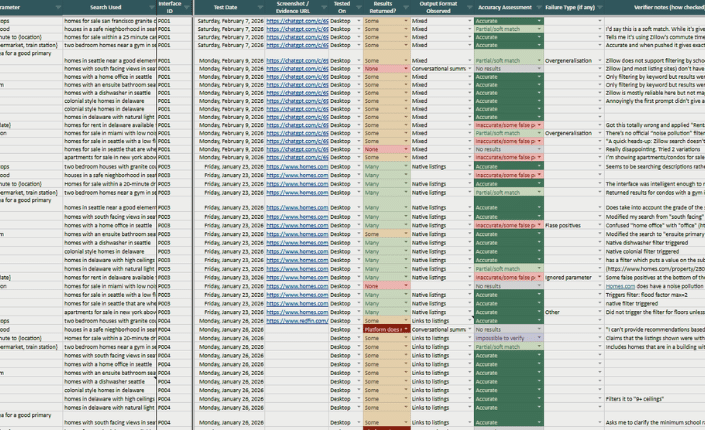
The State of AI in Real Estate Search report set out to answer that question. Over two months, I tested 22 different real estate search interfaces across incumbent portals, challenger portals, PropTech platforms and large language models. The aim was simple: behave like a normal user and see what happened.
The results suggest the biggest constraint on AI-powered search isn’t the AI, it's the data behind it.
Despite the surge in announcements and press releases, AI-powered search remains relatively uncommon on real estate portals.
At the start of 2025, only a small number of portals had implemented any form of conversational or prompt-based property search. By early 2026, that number had more than doubled. But it's doubling from a very low base.
Across roughly 900 real estate portal websites tracked worldwide, only 23 currently offer some form of AI-powered search interface.
Even among those who have built it, many appear cautious about putting the feature directly in front of users. A significant proportion are experimenting with AI search in mobile apps or external integrations before committing to a homepage rollout. In several cases, portals that had previously launched AI search removed or scaled back the feature. The pattern suggests that many companies are still trying to understand how and if AI search should fit into the traditional property portal model.
And as the benchmarking results show, launching the interface is the easy part. Delivering accurate results is much harder.
One of the most striking findings from the research was which types of platforms performed best. The report groups performance by category: incumbent portals, challenger portals, PropTech players and large language models.
While a couple of specialist proptech platforms that don't operate as traditional marketplaces performed well on accuracy, there wasn't much in it between specialists, incumbents and challengers.
Large language models were inconsistent as standalone property search engines. They were excellent at understanding queries but far less reliable when it came to surfacing accurate listings.
The strongest predictor of performance across the tests was whether the requested parameter existed in structured listing data from agents.
When queries relied on parameters commonly structured in listings (things like bedrooms, price or property features), platforms unsurprisingly performed relatively well. When queries relied on contextual or subjective information (neighbourhood safety, pollution levels, lifestyle features), performance dropped dramatically.
Across the benchmark, platforms performed more than four times better on objective parameters than subjective ones. When platforms lacked the data required to satisfy a query, they frequently dropped part of the request entirely and, in doing so, lost my trust as a user.
The problem wasn’t that AI couldn’t understand the request, but that the platform often didn’t have the data required to answer it. Mat Hayward of AI infrastructure company NeuralIndex, interviewed for the report, summed up the challenge succinctly:
“Property portals have great datasets by 2005 standards. But if you want conversational search that answers real-world questions, the underlying data just isn’t deep enough yet.”
Without enrichment layers such as semantic image indexing, geospatial context or environmental datasets, many queries simply cannot be resolved.
Another surprising finding was how little input and output formats influenced accuracy. Some platforms relied on conversational chat interfaces while others combined natural language queries with traditional filters, but there was no meaningful correlation between interface style or output format and performance.
Interface design is relatively easy to change, but the quality and depth of the underlying data are not.
If you subscribe to our free newsletter, the report is already in your inbox. If not, you can download the 34-page report for free here.

Kleinanzeigen has introduced a map-view property search function to its real estate vertical. The feature is available on desktop and...
Read More
TX Group AG has acquired 3,426,731 registered shares of SMG Swiss Marketplace Group, increasing its stake from 31.4 to 34.9...
Read More
We have a People Roundup for you this week, starting in the United States... North America: CoStar Group appoints...
Read More
Zillow Preview listings are now live on Realtor.com, offering the same early access on the two most-visited real estate platforms...
Read More