
CEO Richard Barton says Zillow made the right decision in shutting down its iBuying business last year after the portal giant posted a $53m loss in its Q3 results, published yesterday. Highlights of the portal's operations for the three months ended September 30th include:
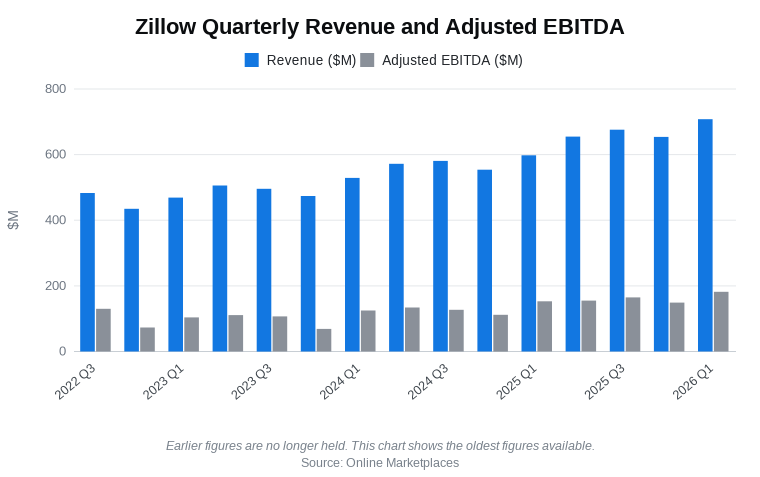
| Quarter | Total Revenue $M | Total Adjusted EBITDA $M |
|---|---|---|
| 2022 Q3 | 483 | 130 |
| 2022 Q4 | 435 | 73 |
| 2023 Q1 | 469 | 104 |
| 2023 Q2 | 506 | 111 |
| 2023 Q3 | 496 | 107 |
| 2023 Q4 | 474 | 69 |
| 2024 Q1 | 529 | 125 |
| 2024 Q2 | 572 | 134 |
| 2024 Q3 | 581 | 127 |
| 2024 Q4 | 554 | 112 |
| 2025 Q1 | 598 | 153 |
| 2025 Q2 | 655 | 155 |
| 2025 Q3 | 676 | 165 |
| 2025 Q4 | 654 | 149 |
| 2026 Q1 | 708 | 182 |
Zillow may have finally rid itself of its iBuying stock but it is still recovering from the failed experiment. However, with earnings per share at $0.35—more than double Wall Street analysts' estimates—and revenues "above the high end" of expectations, Zillow is confident of refloating the ship sooner than expected.
Barton said:
“We’re making progress in each of our growth initiatives: touring, financing, seller solutions, enhancing our partner network and integrating our services. Having a well-capitalized business that produces operating cash flow gives us an advantage in navigating the choppiness of the current housing market."
On Zillow's iBuying business, Barton said:
"Twelve months later, we feel we made the right decision to wind down our iBuying operations, particularly given how this year has played out and I am pleased that as of September 30th, we have no more inventory on our balance sheet."
While the macro housing environment and the termination of its iBuying saw a 12% year-on-year drop in revenue for the quarter, Zillow will be pleased with the better-than-expected performance in its IMT segment which includes its flagship Premier Agent product.
While IMT revenues were down 5% year-on-year at $457m, they exceeded the high end of the company's outlook range for Q3. A letter to shareholders highlighted the "conversion rates, customer connections and retention rates" for Premier Agent which all seem to have weathered the impact of rising interest rates and decreasing house prices in the U.S.
There was also better-than-expected performance for Zillow's rentals segment which generated revenues of $74m, a 10% increase year-on-year.
The picture was not so rosy for Zillow's much-maligned Mortgages business which has consistently struggled to return a profit. Q3 saw Zillow Mortgages bring in $26m in revenue (down 63% YoY) and a $27m Adjusted EBITDA loss. The outlook for Q4 gets even worse with the company predicting further drops in both metrics as the market continues to punish mortgage operators.
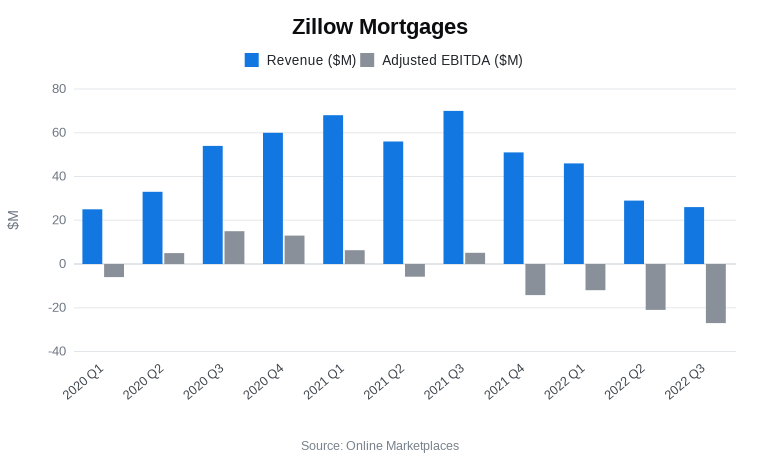
| Quarter | Mortgages Revenue $M | Mortgages Adjusted EBITDA $M |
|---|---|---|
| 2020 Q1 | 25 | -6 |
| 2020 Q2 | 33 | 5 |
| 2020 Q3 | 54 | 15 |
| 2020 Q4 | 60 | 13 |
| 2021 Q1 | 68 | 6.3 |
| 2021 Q2 | 56 | -5.8 |
| 2021 Q3 | 70 | 5.1 |
| 2021 Q4 | 51 | -14.2 |
| 2022 Q1 | 46 | -12 |
| 2022 Q2 | 29 | -21 |
| 2022 Q3 | 26 | -27 |
If Zillow is to snap the narrative of tech company failure which has coloured the headlines about the Seattle-based company since it announced its exit from its iBuying venture this time last year it will need the development of its much-heralded 'housing super app' to be a success.
First hinted at by Barton in a Q4 letter to shareholders and described by the company as "a single digital experience to help customers across all their real estate needs", the app remains in development with no more concrete details forthcoming from company execs.
Clues about Zillow's general direction of travel aren't hard to find though. The company is pursuing three interesting pilot programs which may well be rolled out across the whole U.S. market over time:
Along with the intriguing partnership with iBuyer Opendoor which remains in development, Zillow is confident that these moves can help it can reach its stated goal of 6% of customer transactions in the U.S. housing market by 2025.

Domain says 1.55 million Australians used it in October without also visiting realestate.com.au, up 27% since July. CoStar Group, which...
Read More
El Economista reports that EQT has initiated plans to divest from its minority stake in the Spain-based marketplace operator idealista,...
Read More
Casavo is at it again in this week's M&A roundup... Europe: Casavo acquires another agency group, this time in...
Read More
We have a cracking product roundup for you this week, including household names from around the world... North America:...
Read More