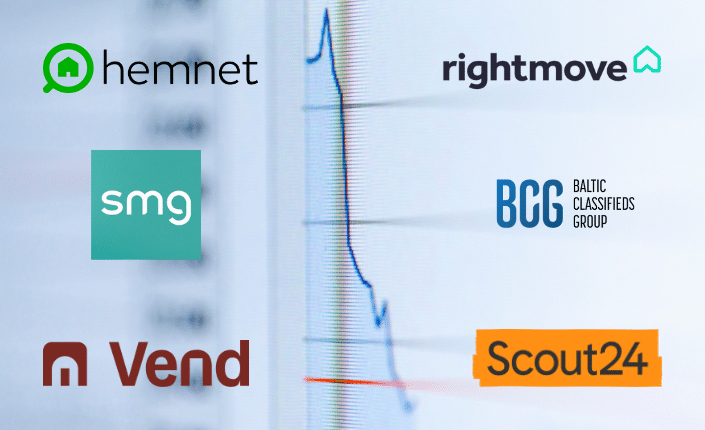
Real estate portal stocks have been a pretty safe bet for a long time. Companies like Hemnet, Scout24 and REA Group have a model beloved by investors and the network effects to fend off competitors.
The 70% margins at businesses like Rightmove and Baltic Classifieds Group have become legendary among investors. But over the last six months, portal operator share prices have been plummeting, and their status as 'investor darlings' might be coming under threat.
What's behind these alarming slides, and could this be the end of the real estate portal banquet?
You would be forgiven for thinking that these deep discounts in portal share prices come on the back of waning performance. In fact of all the major publicly traded European portal operators, apart from Hemnet (increased competition and a down-market), saw double-digit profit growth in their latest reports to the market.
Portal business growth rates may not be what they were ten years ago, but most leading businesses have been on par with Silicon Valley tech giants for the past five years.
Are investors realising that leading portals are running out of juice to squeeze from their agent customers?
To take Rightmove as an example, based on 2023's numbers, we estimated that the portal's revenues accounted for between 8% and 9% of agency commissions in its domestic market. While this may seem like a lot, in an investor presentation that same year, Rightmove's management said that the company believed that it still had "plenty of headroom", pointing to "historic precedents for agents spending more than 15% on marketing".
The question of take rate ceilings is a contentious one and, as long as agents continue to stump up their earnings, a purely theoretical one.
On a recent episode of the PPW Podcast, EIV Founder and CEO Malcolm Myers said that there should be no ceiling for how much an agent would be willing to pay a portal for good leads. Former REA Group CEO Simon Baker disagreed, arguing that for agents dealing with transactions that aren't guaranteed to go through, "there's a natural limit" to what portals can charge for marketing.
Where the idea of a ceiling does seem to be emerging from the theoretical shrouds is not in terms of how much portals can make from agents, but how they make it.
There is an increasing consensus among industry observers, if not yet necessarily among the portals themselves, that charging agents to show their listings at the top of search results is an anachronistic way of doing business in a world where user search queries are becoming more specific.
Logic dictates that as users come to expect portals to be able to match queries that specify things like "20-minute commute from the office", "south-facing garden" or "granite countertops", they'll have a lower tolerance for premium listings at the top of results that don't match their ever more granular searches.
"The changes we see in search and how users are going to interact with your portal will have to drive a change in how we set up our business models. So instead of asking our customers to pay for visibility, we need to adapt our business models to actually get paid for the value we give our customers." Former FINN.no and Property Finder Execitive Frode Nordseth on stage at the recent PPW conference in Madrid
"I think that portals will have to find a different way of charging. It may be that they bump up subscription rates or they may layer on more stuff on top." Malcolm Myers on the PPW Podcast
It's entirely plausible that, as portals get to grips with this new reality and devise a way out of their premium listing dependency, investors take their money elsewhere.
There is also the looming spectre of AI. There have been plenty of LinkedIn commentators speculating (and agents wishfully thinking) that AI platforms could be the downfall of middleman portal businesses that have never owned the transactional layer of the real estate industry.
As Malcolm Myers points out, however, for all the fearmongering, the big LLMs' effect on real estate portals may have been slightly overstated in some quarters.
"I think many analysts confuse the role of LLMs. They're assuming that all the content is coming from direct scraping [agents' sites]. And what is actually the fact is that most content on LLMs today is actually coming from portals and all topped up with some third-party agencies. But you have to remember that the LLMs also have a model. They also have to pay for their compute. And it's not very efficient either in time or in money for them to basically recreate a Rightmove every time someone has a query."
At least one of the big LLM operators seems to have chosen the path of portal partner rather than competitor. OpenAI has now partnered with Zillow, Scout24 and REA Group, and it seems unlikely that other big AI players will see much to gain (at least in the medium term) from angering their potential portal partners by becoming real estate search engines.
As for the threat from smaller AI-native property search platforms, for now, it isn't developed enough to have caused the $15 billion drop in European portal operator market caps.
While there is at least one smaller player with arguably better search tech than the big portals (Jitty) and several others (MyPorta, Zefir, Semanta.ai and others) with concepts that, with enough funding and luck, could theoretically challenge the hegemony of the big brands, a challenge from within the PropTech industry still seems a long way off for now.
Below: Real estate portals have been investing heavily in AI
According to Myers, the most likely explanation for the big slide in portal prices seems to be that investors are waking up to the possibility that the 70% EBITDA margin days are, at least for now, in the past as marketplace operators enter 'investment phases' to make sure that they can offer something on a par with the experience of an LLM.
"Investors look for themes and then they tend to act when they see specific events that act as catalysts. The greatest catalyst in the past three months was Rightmove's Trading Update that I think was interpreted presumably in a way that the PR team had not expected. And I think what was the most clear message there was that they believe that for the next couple of years, they're going to be, that EBITDA margin will be going down." Malcolm Myers
What makes the recent slide in public real estate marketplace valuations particularly striking is that the implied loss of confidence is not mirrored on the private side. If anything, long-term capital still appears comfortable underwriting the sector. Over the past two years, private equity firms have continued to deploy significant sums into portal businesses, seemingly unfazed by short-term market sentiment or margin compression.
The most active name in recent years has been Apax Partners. The London-based firm has written sizeable cheques for At Home in Luxembourg and Yad2 in Israel, moves that have not gone unnoticed by industry observers. As Myers noted,
“It’s very interesting that at the same time that the ‘traders’ are trading out, the people who have the deepest understanding of the market are buying. And that’s very significant.”
In other words, the capital with the longest memory is still backing portals’ network effects and structural advantages.
The same dynamic applies to AI. While fears of disruption have weighed heavily on listed valuations, investors closer to the operational realities appear more sanguine. In a recent update, activist portal investor GCQ argued that,
“While we think the narrative that AI will disrupt property portals is overblown, we believe AI-based search tools will be valuable for users.”
GCQ's update also noted that portals including Hemnet, Rightmove and Swiss Marketplace Group have already signalled their intention to integrate AI-driven search, with management teams suggesting that costs will be minimal for businesses running modern cloud-based platforms.
Seen through that lens, the current downturn looks less like the end of the banquet and more like a pause while expectations reset. EBITDA margins may dip, growth may slow and investors may demand clearer answers on pricing models, but the fundamentals that made portals such compelling businesses have not disappeared.
Network effects remain intact, agents are still paying, and private capital is still buying. For now, at least, reports of the portal sector’s demise appear to be exaggerated.

Charlie Cinolo, head of sales in Italy at Casavo, has told Simplybiz.eu that the former iBuyer-turned-broker is taking a page...
Read More
Three major Norwegian media groups have entered a joint venture to take on digital classifieds in Norway. Schibsted Media (which...
Read More
StreetEasy is getting strict on private listings, barely two weeks after imposing a ban on new Compass agents joining its...
Read More
The Swedish real estate portal Hemnet has paused its share buyback program amid a board shakeup and declining listing volumes....
Read More