
We processed 217,000 listing images across 23 portals in 17 countries. AI adoption at the listing image layer is further ahead than most observers assumed. The infrastructure to help buyers understand what they are seeing has not kept pace.
Real estate agents adopted AI image tools years before most industries had a strategy for them. Virtual staging that takes minutes instead of days. Sky replacements that turn a grey morning into a clean, well-lit exterior. Colour corrections that make a room look the way it looked before three years of furniture accumulated. These tools are genuinely useful, and agents have used them accordingly.
What has not kept up is the buyer-facing infrastructure sitting between agents and portals: the point at which a buyer can know, at a glance, whether the image they are looking at has been processed. Most portals have internal moderation, terms of service, and agent guidelines, but visible in-image disclosure for buyers is almost entirely absent across the industry. That gap is what the Global Property Portal Index set out to measure.
A disclosure upfront: Coraly builds AI listing tools deployed by agents across multiple markets, and runs the Global Property Portal Index, an independent health benchmark that gives portals a continuous score, competitive benchmark, regulatory readiness assessment, and action playbook across 158 metrics and 400 signals. That position on both sides of the market means we approach this as practitioners rather than analysts. The image alteration analysis in this article is one chapter of that larger benchmark. We publish it because the industry deserves a consistent, independent measure of where portals stand, and because you cannot improve what you do not measure.
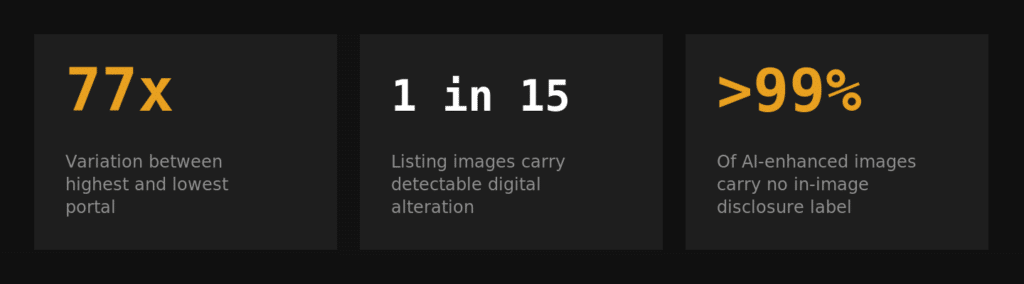
One in fifteen images globally shows detectable AI enhancement. That average spans a 77-fold range from the highest-rate portal to the lowest, and the pattern in that spread is worth reading carefully. The portals at the top are not there because of lax standards. They are there because they operate in markets where agents have embraced AI tools most thoroughly: the UAE's off-plan development sector, the US's highly competitive residential market, and Australia's professionally demanding listing environment.
It is also worth being precise about who is doing what. Portals do not alter listing images. Agents do, or photographers, or stagers working on behalf of agents. The portal's role is in the moderation layer: do they have the infrastructure to detect AI-processed images, and do they give buyers any signal about what they are viewing? Most do not yet. That is the infrastructure gap this index is designed to measure.
Virtual staging accounts for the largest share of detected enhancements. Sky replacement is close behind. Object removal is the smallest category by volume but the most consequential when the removed object is something a buyer would want to know about, a neighbouring building, a pylon, a view obstruction that does not match the listing.
CGI-adjusted AI-enhancement rate per portal, off-plan architectural renders excluded. Bars are coloured by region. The markets where agents have adopted AI tools most thoroughly, MENA, North America and Australia, cluster at the top. Figures are estimates from Coraly's automated image-alteration detection across a Q1 2026 sample of approximately 10,000 images per portal. Detection is probabilistic, and the full methodology and per-portal confidence ranges are in the report. Data: Coraly GPPI Global Edition, Q1 2026. 217,694 images across 23 portals.
The most useful comparison the data allows is within the same country, where market dynamics and regulatory environment are held constant. What varies is the agent community each portal has attracted and the moderation approach each portal has chosen.
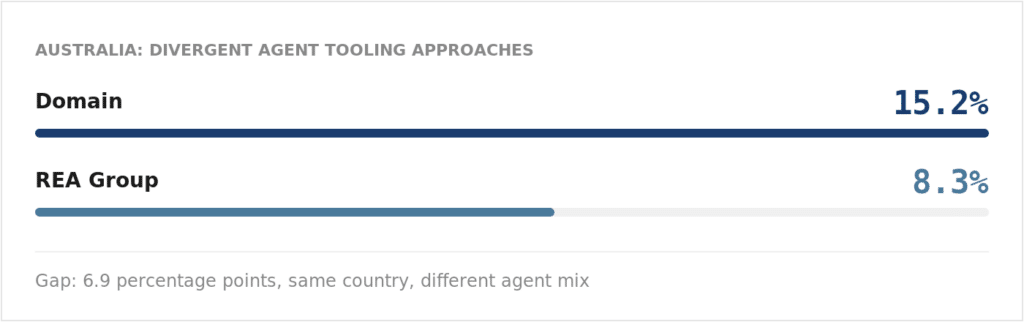
Australia's intra-market gap is worth understanding rather than simply noting. Domain, now part of CoStar Group, and REA Group both serve sophisticated Australian buyers with strong technology investment behind them. The 6.9 percentage point spread most likely reflects different agent community profiles and different approaches to what gets uploaded, moderated, and surfaced. Neither figure is a verdict. Both are data points for the respective product teams.
"In a market like the UAE, where audiences come from diverse backgrounds with very different expectations around property presentation, this balance becomes even more important. Some buyers are used to highly staged visuals, while others prioritise raw accuracy. Platforms and marketers have a responsibility to navigate this spectrum thoughtfully." - Sahar Khan, Vice President of Marketing and Communication at Bayut
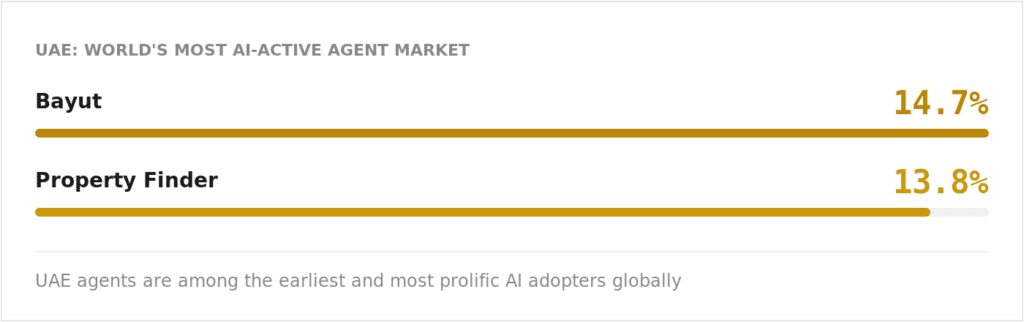
The UAE picture is different in character. Dubai's off-plan development market is one of the world's largest, and agents operating in it have used professional presentation tools, CGI renders, virtual staging and high-production photography, at scale for years. The CGI-adjusted figures shown here already strip out off-plan renders. What remains reflects how deeply AI enhancement tools have penetrated the broader agent community. That is a sophistication story.
The first portal to turn AI detection into a visible buyer benefit, rather than a backend moderation function, will own the trust story in its market. The technology to do it exists. The window to do it first is open.
Agents enhancing listing images is not the issue. The issue is whether portals have built the infrastructure to give buyers any signal about what they are looking at. Currently, almost none have.
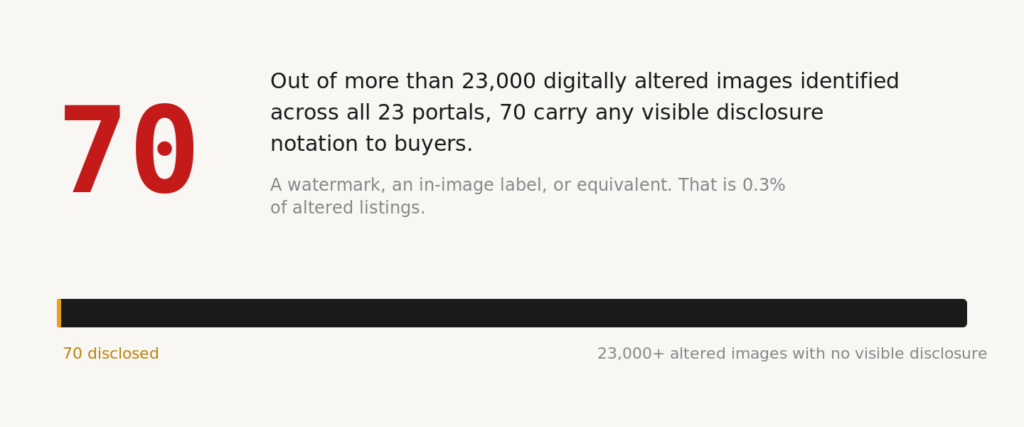
AI enhancement of listing images is legal in virtually every market we examined, and in most cases it reflects agents doing their job well. The gap is in the buyer's experience: when a photo has been processed, buyers currently have no way to know. The 70 images that do carry a visible label prove the technology to close that gap exists and has been deployed. The question is why it has not spread further.
The gap between 70 and 23,000 is not a capability gap. Detection models exist. Portal upload pipelines are the natural place to apply them. The 70 disclosed images are a proof of concept, not an outlier.
For most of the last decade the legal question was simple: an agent must not mislead. That is changing. The newer wave of rules is less concerned with who made the edit and more with whether the buyer can see that an edit was made, and whether the original is a click away. As that question moves from the agent to the platform that distributes the image, portals move into the frame.
The specifics differ by market. The direction does not. Regulation is converging on provenance: the buyer's right to know what was changed, and to see the original. The content-authenticity standards now spreading across the wider media industry point the same way.
Portals that build detection and disclosure into the upload pipeline now will hold a structural advantage before any of this hardens into a requirement. Early movers on trust infrastructure find it easier to attract quality-conscious agents, retain high-intent buyers, and meet regulators with data rather than catch-up.
I am not making a compliance argument. I am making a product argument.
Trust does not show up in complaint logs. Buyers whose viewing experience does not match the listing photos online do not write to the portal. They quietly reduce their time on site, convert at lower rates, and are more likely to try a competitor next time. The signal is diffuse, spread across engagement metrics rather than concentrated in a single legible number, which makes it easy to miss without active measurement.
The portals that move first on disclosure will not do so because a regulator made them. They will do so because they figured out, before their competitors did, that trust is a product feature with measurable return. The data to build it exists. The tools to implement it are available today. The regulatory wind is already at their backs.
That is a rare moment for any product team.

Square Yards has closed a $95 million capital raise, and it is not done yet. The Indian proptech firm says...
Read More
CoStar Group and five of the largest commercial real estate brokerages in the US have been named in a proposed...
Read More
Scout24 paired record results with a much bigger payout at its 2026 annual general meeting in Munich on the 17th...
Read More
Rightmove has thrown its weight behind a sweeping set of government proposals that would reshape what sits on a home...
Read More